
Meditation, journaling and focus resources worth your money
Grounded, non-denominational practices for a calmer mind — no retreat, tradition, or particular belief system required.
Every number on this page names its source.
Heads up: we earn a commission if you buy through links on this page, at no extra cost to you. It doesn't change what makes the list. How we choose
The problem isn’t discipline. It’s starting in the wrong place.
Most people reading this already believe a calmer mind is a good idea. That's not the gap. The gap is that this market sells everything at once (apps, retreats, courses, “brainwave” audio, readings) and the loudest sellers lean on promises no practice can keep. Buying the wrong thing first is how people end up with three meditation apps they opened twice. Almost nobody needs any of it on day one: a timer and five quiet minutes is a real start.
of U.S. adults meditated in the past 12 months, about 60.5 million people. Interest isn’t the gap.
NHIS 2022, Scientific Reports 2024median 30-day retention across 93 mental health apps. Staying with it is the gap.
Baumel et al., JMIR 2019Can't sit still
You've tried, and your mind ran the whole time.
Start with meditationWound up, can't come down
You need something that works in five minutes, not fifty.
Start with breathworkHead full, nothing processed
Thoughts loop. You want somewhere to put them and a way to decide.
Start with journalingCurious about readings
Astrology, tarot or a soulmate sketch, just for fun. Know what you're buying first.
Read this firstWhat "enough" actually means, so you can judge any product
There's no official minimum for stillness. What we do have is what trials actually tested, and how little the “brainwave” audio research agrees. These are the yardsticks we use.
108 adults, mostly students, practiced five minutes a day for a month. Cyclic sighing (long exhales) raised positive affect by about 1.89 points a day, against 1.22 for mindfulness meditation. People with moderate to severe psychiatric or medical conditions were excluded. One study.
Balban et al., Cell Reports Medicine, 2023
47 trials, 3,515 participants. Moderate evidence of small improvements in anxiety (effect size 0.38 at 8 weeks), depression (0.30) and pain (0.33). Low evidence for stress. No evidence it beat active treatments.
Goyal et al., JAMA Internal Medicine, 2014
A 2023 systematic review found 5 studies in line with the idea that binaural beats sync brainwaves, 8 that contradicted it and 1 mixed. Methods varied widely. For focus audio, the honest answer is “unclear”, not “settled”.
Ingendoh et al., PLOS ONE, 2023
You don't need an hour or a silent room
The tested breathing dose was five minutes. The tested programs ran for weeks of regular practice, not a day-long retreat. If a product says you need a retreat, an hour or an "empty" mind to begin, that's the tell.
Free first, paid second
A timer, a notebook and five minutes of slow breathing cost nothing. Paid audio or a guided program earns its price by making the habit easier to repeat, not by doing something the free version can't. Try the free version for two weeks. If you still want more structure, that's the time to buy.
Nothing here treats a health condition or predicts your future
NCCIH: don't use meditation or mindfulness to replace conventional care or as a reason to postpone seeing a provider. If you're in crisis, call or text 988. Readings are for entertainment purposes only.
NCCIH
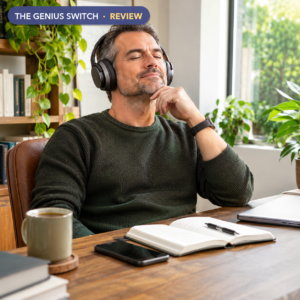
The Genius Switch: our current pick for people who like focus or relaxation audio and want a long refund window
A $39 digital audio series pitched as brain-boosting. 90-day refund. Listening routine not published before purchase. $39 one-time · 90-day money-back guarantee (terms apply).
Where focus audio and readings fit, and what we check before linking one
Focus audio and readings sit at the edge of this page. Audio can be a pleasant cue to sit down and settle, and a reading can be a fun gift. But neither is a practice the way meditation or journaling is, and both are often sold with bigger promises than the evidence supports.
That's why they get their own checks. “Brainwave” audio is often marketed with brain or memory language that no study of the product itself supports. Readings are sold as insight while the seller's own small print says entertainment.
of U.S. adults consult astrology, a horoscope, tarot cards or a fortune teller at least once a year.
Pew Research Center, 2025
say they rely a lot on these practices for major life decisions. 20% use them mostly just for fun.
Pew Research Center, 2025
Six checks before an audio program or reading gets a link
Who makes it
A named seller, a working contact or support route, and a known payment platform such as ClickBank. If we can't tell who's behind it, it doesn't get a link.
Refund terms we've read
The window in writing, and how to claim it. For example, 90 days for The Genius Switch and 30 days via ClickBank for the Tina Aldea sketch. Terms that only appear after checkout count against it.
No promised outcomes
We never repeat a promised result. If a seller's page promises more than it can show, like a sharper brain or when you'll meet someone, our card says so in plain words and the review explains why.
No fear or pressure
No curses, “blocked energy” or bad luck you have to pay to remove. No countdown timers, no “only 3 readings left”. A practice bought in a panic rarely gets practiced.
Entertainment framing for readings
Every reading, astrology or sketch card says “for entertainment purposes only”, and so does its review. If a sketch is AI-generated, we say that too.
Upsells disclosed
The card shows the starting price and says whether order bumps, upsells or a subscription follow. You should know the full shape of the purchase before you click.
What we won't link, ever
No commission rate changes this list.
- Readings that use fear (curses, danger, bad luck) to make you pay for more
- Anything that claims to treat, cure or prevent a disease, including memory loss or dementia. The Genius Switch's sales page cites dementia research while its small print says it doesn't treat or prevent any disease. We link it only as focus and relaxation audio, we don't back that framing, and our review says so.
- Countdown timers, fake stock counters and "last chance" pricing
- Audio sold on IQ scores or “rewire your brain in days” claims we're asked to repeat
- Practices that tell you to stop medication or skip professional care
- Testimonials or results we can't trace to a real, named source
We look past the vague promises
Says what it is
Secular, or rooted in a named tradition? The card says which, so you can choose without guessing. We don't rank traditions.
States its dose
Minutes per day and weeks in total, set beside the tested doses above: five minutes for breathing, about eight weeks for a structured mindfulness program.
Works in a real week
A kitchen at six a.m., no special room and no hour to spare. Nothing beyond what's already in the house.
Honest about risk
NCCIH cites a 2020 review in which about 8 percent of participants had a negative effect from meditation, most often anxiety and depression. Breathwork built on forced over-breathing or long breath-holds needs its own warning, and we say who should check with a clinician first.
No health claims, no promises
Not "cures anxiety," not "rewire your brain in 7 days," not "attract what you want." Describe the practice, not the outcome.
Priced, supported and re-checked
Dollar pricing, a refund window we've read, a visible cancel path and no ladder of paid "levels." Re-checked when prices, versions or evidence change.
Resources we're finalizing
Browse by category — we're still testing before we put our name behind anything.
A practice and a reading aren't judged on the same things, so each card shows what matters for its kind: time and refund terms for audio and practices, price and the entertainment-only frame for readings.
Want more picks like this?
Optional: leave your email and we’ll send honest reviews and guides for Spiritual Growth, with the downsides included. Or skip straight to the offer below.
Thanks, you’re on the list. Unsubscribe anytime.
Continue to the offer →Affiliate link: we may earn a commission, at no extra cost to you. How we make money
Side by side
Every pick, side by side. Read the “what we verified” column first: it's where we note refund terms, upsells and what the seller's own small print says.
| Pick | Type | Best for | What we verified | Cost | Action |
|---|---|---|---|---|---|
| Tina Aldea Soulmate Sketch | Psychic reading | Novelty gift, entertainment only | Price, delivery and refund terms checked Oct 2026 | $37 for the sketch | See full review |
| The Genius Switch | Audio series | Focus/relaxation listening | Price and refund terms checked Oct 2026; listening protocol not published | $39 one-time | See full review |
Prices, refund terms and seller disclaimers checked October and November 2026. We re-check prices monthly, and terms and upsells quarterly. The seller's site is the final word on today's price.
Prices may differ: we update them monthly, and the official site always shows the current price, including shipping and any add-ons.
Questions people ask at this stage
Do I need to be religious or spiritual?
No. In Pew’s 2023 survey, 70% of U.S. adults described themselves as spiritual in some way and 22% as spiritual but not religious. (Pew, 2023) Every practice we link says whether it’s secular or rooted in a tradition, and we don’t rank them.
Does meditation actually work?
For some things, modestly. A widely cited 2014 review of 47 trials and 3,515 participants found moderate evidence of small improvements in anxiety, depression and pain, and low evidence for stress. It found no evidence meditation beat active treatments such as drugs, exercise or other behavioral therapies. (Goyal et al., 2014) NCCIH adds that much of the research has been preliminary. (NCCIH)
Is breathwork safe?
The tested practice was slow, paced breathing with long exhales for five minutes a day, in adults without moderate to severe psychiatric or medical conditions, mostly students. (Balban et al., 2023) That is a different thing from breathwork built on forced over-breathing or long breath-holds, which carries its own cautions. If you’re pregnant, or have a heart, seizure or breathing condition, check with a clinician first. Every breathwork product we link has to say so.
Can meditation or journaling replace therapy?
No. NCCIH: “Don’t use meditation or mindfulness to replace conventional care or as a reason to postpone seeing a health care provider about a medical problem.” It also cites a 2020 review in which about 8 percent of participants had a negative effect from meditation, most often anxiety and depression. (NCCIH) If you’re in crisis, call or text 988.
Does journaling help?
A little on average, and more when it’s done a certain way. Across 146 randomized studies, expressive writing had a small but reliable effect (r = .075), larger with specific instructions that push you toward making sense of an event, and larger with weekly than with daily sessions. (Frattaroli, 2006) That’s why we favor prompts built to process over pages of venting.
Does manifestation work?
Picturing a perfect outcome, on its own, can backfire. In four experiments, positive fantasies about an idealized future produced less energy and less accomplishment than fantasies that questioned the desired future. (Kappes & Oettingen, 2011) The related research on mental contrasting points toward pairing the wish with the obstacle in the way and a concrete plan. We link intention tools built that way and flag the ones built on “the universe will deliver.”
Are psychic readings and soulmate sketches real?
Treat them as entertainment. There's no reliable way to check a reading. The soulmate sketch we cover says so itself: its readings are for entertainment purposes only and a sketch may not be unique, and its vendor describes the sketches as AI-generated. In Pew's 2025 survey, 20% of U.S. adults used astrology, tarot or fortune tellers mostly for fun, and just 1% relied on them a lot for big decisions. (Pew, 2025) As a fun and meaningful gift idea, fine. As the reason to start or end a relationship, no.
Do you get paid for these recommendations?
Yes. We earn a commission if you buy through links on this page, at no extra cost to you. It doesn’t change what makes the list: every pick clears the same six standards, and commission rate isn’t one of them. We don’t sell anything of our own. If that changes, our own products will carry a separate “Our own product” badge and won’t sit in a list framed as independent picks.
Do binaural beats or “brainwave” audio work?
The research is mixed. A 2023 systematic review found 5 of 14 studies in line with the idea that binaural beats sync brainwaves, 8 that contradicted it and 1 with mixed results, and the methods varied widely. (Ingendoh et al., 2023) If you enjoy focus audio, it can be a pleasant cue to sit down and start. Where a seller talks about your brain or memory, our review says whether any study tested that product.
Stillness is one part of the picture
Body, relationships, and mind move together. Keep exploring, or join the list for all three.