
Bad sleep strains a relationship by making both of you shorter-tempered, worse at reading each other, and less able to settle a disagreement. In one study of dating couples, people reported more conflict with their partner on days after a poor night’s sleep, even if they normally slept well. The good news is that sleep is something you can work on together, and small changes can take some heat out of everyday friction.
Key takeaways
- Poor sleep and conflict go together. Studies link a bad night to more fights the next day and to harder, less resolved arguments.
- It affects how you argue, not just how often. Tired partners read each other’s emotions less accurately and feel more negative during disagreements.
- Both partners’ sleep matters. Arguments were more hostile when both people had slept less.
- Simple rules help: no big talks when exhausted, say “I’m tired, not angry”, and protect sleep as a team.
- Snoring, ongoing insomnia or heavy daytime sleepiness are worth raising with a doctor.
What the research says
A bad night means more fights the next day
Psychologists Amie Gordon and Serena Chen at the University of California, Berkeley studied sleep and conflict in romantic couples. In one study, 78 young adults in relationships kept daily reports for two weeks. They reported more conflict with their partner on days after poor sleep. In a second study, 71 couples came into the lab and discussed a source of conflict on camera. People who had slept poorly, and their partners, reported more negative feelings during the talk. Poor sleep was also linked to weaker conflict resolution and to less accurate reading of a partner’s emotions (UC Berkeley News, 2013).
Writing about the work, Gordon explained that the link held after accounting for stress, anxiety and depression. Couples were most likely to resolve a problem when both partners were well rested, and one poorly rested partner was enough to make it harder. She also noted that the findings don’t prove poor sleep causes conflict (Society for Personality and Social Psychology blog; study: Gordon and Chen, Social Psychological and Personality Science, 2014).
When both partners are short on sleep, arguments get sharper
A study of married couples at Ohio State University asked partners about their recent sleep, then had them discuss a marital problem. People who reported shorter sleep showed a larger rise in inflammatory markers after the discussion. When both partners had slept less, their interactions were more hostile. Couples who used healthier ways of handling emotion during the talk showed less of that response (Wilson et al., 2017, Psychoneuroendocrinology).
That last point matters. It suggests sleep loss doesn’t make conflict inevitable. It makes it harder to handle well, and the skills you use in the moment still count.
Why tiredness does this
The Sleep Foundation notes that without enough sleep you’re more likely to feel irritable and to use poor judgement, and that sleep helps people regulate their emotions. Over time, it says, sleep loss can cause relationships to suffer at work and at home (Sleep Foundation, “Why Do We Need Sleep?”).
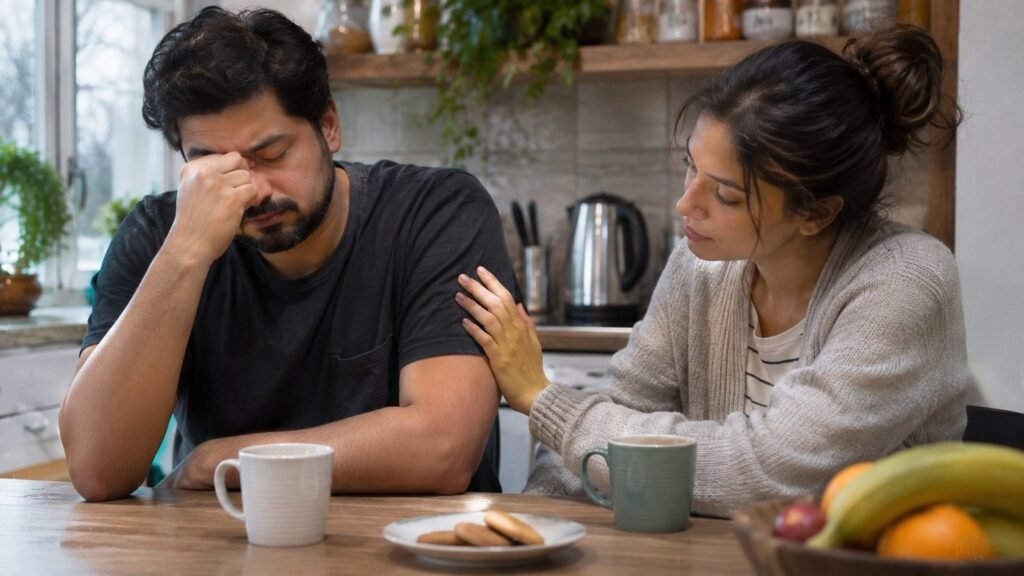
How it shows up at home
- Small things feel big. A sigh or a dish left out lands harder than it would on a good day.
- You misread tone. A neutral question sounds like criticism.
- Repair takes longer. You stay annoyed after the moment has passed.
- Less warmth and fun. When you’re running on empty, affection and play are often the first things to go.
- Night-time friction. Different bedtimes, a restless sleeper or snoring can become a fight of its own. In a 2024 Sleep Foundation survey of 1,000 US adults whose partner snores, 75% said the snoring affects their sleep, and 19% of those with a habitual, loud snorer said it strains the relationship (Sleep Foundation).
What helps
1. Make a “not tonight” rule for big talks
Agree that serious topics wait until you’ve both slept. Money, in-laws and the future can be talked about over breakfast at the weekend, not at 11:30 pm. This isn’t avoiding the issue. It’s choosing the moment when you both have the most patience.
2. Name it out loud
“I’m really tired and I’m being short with you. It’s not about you.” That one sentence can stop a small snap turning into a fight. It also gives your partner permission to say the same.
3. Start gently when you do raise something
The way a conversation starts tends to shape how it ends. Lead with what you feel and need, not what your partner did wrong. Our guide on how to ask for what you need without starting a fight walks through it.
4. Protect sleep as a team
The CDC says adults aged 18 to 60 need 7 or more hours a night. Its sleep habit tips include going to bed and waking at the same times each day, keeping the bedroom quiet, relaxing and cool, switching off devices at least 30 minutes before bed, and avoiding large meals, alcohol and late caffeine (CDC, “About Sleep”). These work better as a couple. If one of you scrolls in bed while the other tries to sleep, that’s a shared problem to solve together.
5. Take snoring seriously, kindly
Snoring isn’t a character flaw. A sleep expert quoted by the Sleep Foundation advises the person who snores to see a doctor to look for causes and rule out sleep apnea. Sleeping on your side may help. Separate rooms can be a reasonable choice if it helps you both sleep, once causes have been checked (Sleep Foundation). Sleeping apart doesn’t mean you’re drifting apart. Being rested can make the time you spend together better.
6. Let the rested one lead
If one of you slept badly, the other can carry a bit more patience that day. Small kindnesses, like taking the morning school run or letting them nap, go a long way.

What about sleep supplements?
This post contains links to our reviews. If you buy through a link on those pages we may earn a commission, at no extra cost to you. How we make money.
Not medical advice. Talk to your doctor or pharmacist before starting a supplement, especially if you take medicines.
Habits come first. Some people also try a supplement such as melatonin or magnesium. The evidence for both is modest, and they suit different situations. We compare them in magnesium vs melatonin for sleep. One product we’ve reviewed is Yu Sleep, a liquid supplement with a low 0.9 mg melatonin dose. It also contains 5-HTP, so it isn’t suitable for anyone taking antidepressants without their doctor’s advice. Most of its ingredients share a blend with no individual amounts listed. Our Yu Sleep review covers the full label.
For more on sleep and energy, see our health section. For communication and conflict, visit our relationships section.
When to get help
- Sleep: if you regularly struggle to sleep, feel very sleepy in the day, or a partner notices loud snoring, gasping or pauses in breathing, talk to your doctor.
- Relationship: if conflict stays high even when you’re both rested, a couples counsellor can help.
- Safety: if arguments involve threats, fear or control, that isn’t about sleep. In the US, the National Domestic Violence Hotline is free, confidential and open 24/7: call 800-799-7233 or text START to 88788. Elsewhere, contact your country’s domestic abuse helpline.
FAQ
Can lack of sleep cause relationship problems?
Research links poor sleep to more frequent and less resolved conflict between partners. The studies show a link rather than proof of cause, and sleep is rarely the only factor.
Why do we argue more when we’re tired?
Tiredness makes people more irritable and less able to manage emotions. In studies, tired partners also read each other’s emotions less accurately and found it harder to resolve disagreements.
Is sleeping in separate beds bad for a relationship?
Not necessarily. If snoring or different schedules keep one of you awake, sleeping apart can help you both rest. Check snoring with a doctor first, and make time to be close in other ways.
How much sleep do adults need?
The CDC recommends 7 or more hours a night for adults aged 18 to 60, with slightly different ranges for older adults.
What’s the quickest fix?
Agree not to have serious conversations when either of you is exhausted. It costs nothing and can prevent a lot of avoidable fights.
Our honest take
Sleep is one of the most overlooked parts of a good relationship. Before you blame your partner, or yourselves, check how you’ve both been sleeping. Habits and a “not tonight” rule do the most. If you’re also curious about a sleep supplement, read our Yu Sleep review and talk to your doctor first.
Want more honest guides like this? Join the WholesomePaths newsletter. One email. Three areas of growth. Zero spam.