
Liquid melatonin, gummies and tablets all contain the same hormone, and we found no good evidence that one form helps you sleep better than another. What matters more is the dose, the timing and whether the label is accurate. Low doses of 0.5 to 1 mg are common because studies suggest small amounts can work as well as larger ones for many people, with less risk of grogginess.
Below, we compare the three formats, explain why low doses keep coming up and share what label tests have found.
This post contains links to our reviews. If you buy through a link on those pages we may earn a commission, at no extra cost to you. How we make money.
Not medical advice. Talk to your doctor or pharmacist before starting a supplement, especially if you take medicines.
Key takeaways
- Format is mostly about convenience. Liquids make small doses easy, gummies are easy to take, tablets are simple.
- Start low. Many experts suggest 0.5 to 1 mg, 30 to 60 minutes before bed.
- Labels often aren’t accurate. In a 2023 study, 22 of 25 melatonin gummies didn’t contain the amount on the label.
- Gummies look like sweets. Keep every form out of children’s reach and sight.
- Melatonin works best for timing problems. Its average effect on everyday insomnia is small.
The three formats compared
| Liquid (drops or shots) | Gummies | Tablets or capsules | |
|---|---|---|---|
| Best for | People who want a small or adjustable dose, or who dislike swallowing pills | People who prefer something chewable | People who want a simple, no-fuss option |
| Dose control | Easy to take less, if you measure carefully | Fixed per gummy; cutting one is messy | Fixed per tablet; some can be split |
| Watch out for | Different strengths per ml or per dropper between brands | Sugar or sweeteners; look like sweets to children; label accuracy problems in tests | Strengths vary widely between products; check the mg per tablet |
| Other notes | Check the amount per serving, not per bottle | Check whether the dose is per gummy or per two gummies | Extended-release versions exist; ask a pharmacist if they suit you |
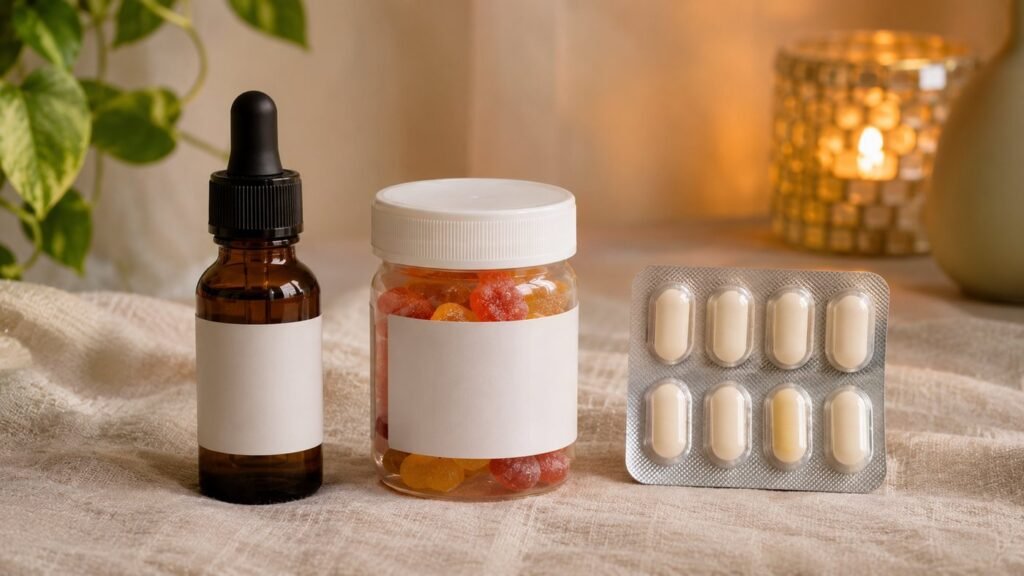
The table is our practical comparison. We didn’t find head-to-head trials showing that one form improves sleep more than another.
Liquid melatonin (drops)
Liquid melatonin comes in drops, sprays or small shots. Its main advantage is control: you can measure a small amount, which suits the low-dose approach many experts suggest. The catch is that strengths vary. One product’s serving might be a full dropper, another’s a few drops. Always read the amount per serving on the Supplement Facts box and use the measuring tool that came with it.
Melatonin gummies
Gummies are popular because they’re easy and taste nice. That’s also the problem. In a 2023 study of 25 US melatonin gummy products, 22 were inaccurately labelled. One had no detectable melatonin. The rest ranged from 74% to 347% of the amount on the label, with most containing 1.2 to 1.7 times more than stated (NCCIH, summarising JAMA, 2023).
Gummies are also a risk around young children. A CDC report estimated about 10,930 emergency department visits from 2019 to 2022 for children aged 5 and under who swallowed melatonin unsupervised. Gummies were the most commonly recorded form. Melatonin products don’t have to use child-resistant packaging, and the CDC says choosing products that do “might be advisable in homes with young children” (CDC MMWR, 2024).
Melatonin tablets and capsules
Tablets are the classic choice. They’re simple, don’t look like sweets and are easy to take at the same time each night. Some are extended-release, designed to release melatonin more slowly. The main thing to watch is strength: check whether the tablet matches the low doses discussed below. If you only find a higher-strength tablet, ask a pharmacist before splitting it, because not every tablet is made to be split.
Why low doses are common
When it comes to melatonin, more isn’t automatically better. There are a few reasons experts lean towards less:
- Small doses can be enough. The Sleep Foundation says studies show that “even as little as 0.5 to 1 milligram” can be as effective as higher doses for many people (Sleep Foundation).
- Higher doses can linger. In a small 2001 study of 30 adults over 50, 0.3 mg improved sleep efficiency in people with insomnia and brought blood melatonin to normal night-time levels. A 3 mg dose also improved sleep, but lowered body temperature and kept melatonin raised into daylight hours (J Clin Endocrinol Metab, 2001). It’s one small study, but it shows why “more” isn’t automatically “better”.
- Fewer side effects. Starting low lets you see how your body responds and may reduce side effects such as grogginess or vivid dreams (Sleep Foundation).
- Long-term safety is unclear. NCCIH notes that the safety of doses above what the body normally makes isn’t well understood (NCCIH).
The Sleep Foundation suggests starting at 0.5 to 1 mg, 30 to 60 minutes before bed, at the same time each night (Sleep Foundation). In several countries melatonin is prescription-only, which is another reason to speak to a doctor (NCCIH).
Label accuracy: a problem in every format
Inaccurate labels aren’t just a gummy problem. A 2017 Canadian study of 31 melatonin products found that more than 71% didn’t meet their label claim within 10%. Content ranged from 83% less to 478% more than stated, and 26% of products contained serotonin. The variation wasn’t linked to the manufacturer or the type of product (J Clin Sleep Med, 2017).
You can lower the risk by choosing products with an independent testing seal, such as USP or NSF, and checking the seal on the certifier’s website. Our guide on how to read a supplement label explains what those seals do and don’t mean.
Who should check with a doctor first
Short-term melatonin use appears safe for most adults, but NCCIH says people with epilepsy or who take blood thinners need medical supervision. Research in pregnancy and breastfeeding is lacking. Older adults may stay drowsy into the next day. Side effects reported in studies include headache, dizziness, nausea and sleepiness (NCCIH).
For children, talk to a health professional before giving any melatonin. It’s also worth knowing that melatonin’s evidence is strongest for timing problems like jet lag. For long-term insomnia, the American College of Physicians recommends CBT for insomnia first (NCCIH). Our post on magnesium vs melatonin for sleep goes into that in more detail.
A low-dose liquid example: Yu Sleep
Yu Sleep is a liquid sleep supplement we’ve reviewed. Its label lists 0.9 mg of melatonin, which fits the low-dose approach above, plus small amounts of vitamins B2 and B6. Seven more ingredients, including magnesium glycinate, L-theanine and 5-HTP, share a 637 mg blend with no individual amounts.
The 5-HTP matters. The body turns it into serotonin, and Harvard Health notes that, in theory, any drug or supplement that affects serotonin can cause serotonin syndrome, a serious condition (Harvard Health). If you take antidepressants or other medicines that affect serotonin, don’t combine them with it without your doctor’s okay. The smallest pack is a two-month supply, and no third-party test is shown. Our Yu Sleep review goes through each ingredient.

For more on sleep, energy and simple habits, visit our Health & Fitness section.
FAQ
Does liquid melatonin work faster than pills?
We didn’t find good head-to-head research showing it helps you sleep faster or better. Liquid’s real advantage is that small doses are easy to measure.
Are melatonin gummies less accurate than tablets?
A 2023 study found most gummies tested were mislabelled, but a 2017 study found inaccurate labels across product types too. A third-party testing seal is a better guide than the format.
What is a low dose of melatonin?
Many experts consider 0.5 to 1 mg a low starting dose. Some studies have used even less, such as 0.3 mg. Check the label, because product strengths vary widely.
When should I take melatonin?
The Sleep Foundation suggests 30 to 60 minutes before bed, at the same time each night. For jet lag or a late body clock, timing advice can differ, so ask your doctor or pharmacist.
Is melatonin safe for children?
Talk to a health professional first. Keep all melatonin, especially gummies, out of children’s reach and sight, and choose child-resistant packaging if you have young children at home.
Our honest take
Pick the format you’ll take correctly, not the one with the nicest marketing. For most adults, that means a low dose, a trusted label and a short trial, alongside good sleep habits. If you’re considering a low-dose liquid, our honest Yu Sleep review covers the pros, the cons and who should skip it.
Want more honest guides like this? Join the WholesomePaths newsletter. One email. Three areas of growth. Zero spam.